

TLDR; We’re thrilled to introduce our partnership with Chemspace, a leading global platform for sourcing small molecules. Perform on-demand synthesizability search across trillions of molecules directly in-line with your existing workflows, physically grounding agentic drug discovery from the start.
In silico drug discovery is only as good as what can be synthesized
Drug discovery is one of the most promising applications for rapidly advancing AI. However, experimental validation remains the ultimate ground truth, and there is an important gap between computationally predicting a lead compound and having a physical vial of that compound on the bench. Existing libraries of drug-like molecules are already too large for exhaustive screening, and even after selecting candidates, often well under half are expected to be synthesizable, and fewer still are successfully produced in practice. At each stage, time and resources can be naively lost to evaluating synthetically unviable compounds, searching for synthesis vendors post hoc, or sourcing the materials or equipment to attempt risky new syntheses in-house.
Screen from the world’s largest catalog of small molecules
Chemspace offers an integrated solution to these challenges by aggregating trillions of molecules with verified synthetic routes from Freedom Space 5.0, Enamine REAL, and many additional providers into a single platform, enabling instantaneous exact-match and analog search with real-time availability, pricing, and lead time. This library of available and make-on-demand molecules provides functional grounding from the very beginning, as well as a simple and consistent procurement process for both individuals and larger organizations.
With our new partnership, screening with Chemspace’s catalog of available and make-on-demand molecules is now as seamless as asking in natural language. Axon, Mirror’s agentic platform for drug discovery, now knows how to query Chemspace directly as part of virtual screening or drug design workflows. There are zero handoff burdens to starting a drug discovery campaign from a targeted library of synthesizable molecules, filtering generated drug candidates based on synthesizability, or searching for synthetically accessible analogs of a hit compound to build structure-activity relationships (SAR). No manual data wrangling or software installation required. Let’s look at some examples below.
“Compound accessibility is most useful when it can inform computational prioritization early. By bringing Chemspace sourcing and make-on-demand chemistry into Axon, this integration gives teams a more direct path from promising computational candidates to compounds for experimental testing.” — Olga Tarkhanova, PhD, CEO, Chemspace
Chemspace × Axon in action
A quick note on scale — screening and design campaigns often require processing tens of thousands of candidates through multiple stages of iteration, which can take hours to days (or more!) of compute. These workflows are intentionally pared down for brevity but can easily be elaborated and scaled up.
Library-specific screening of KRAS G12D inhibitors for pancreatic cancer, an active space where speed-to-bench matters
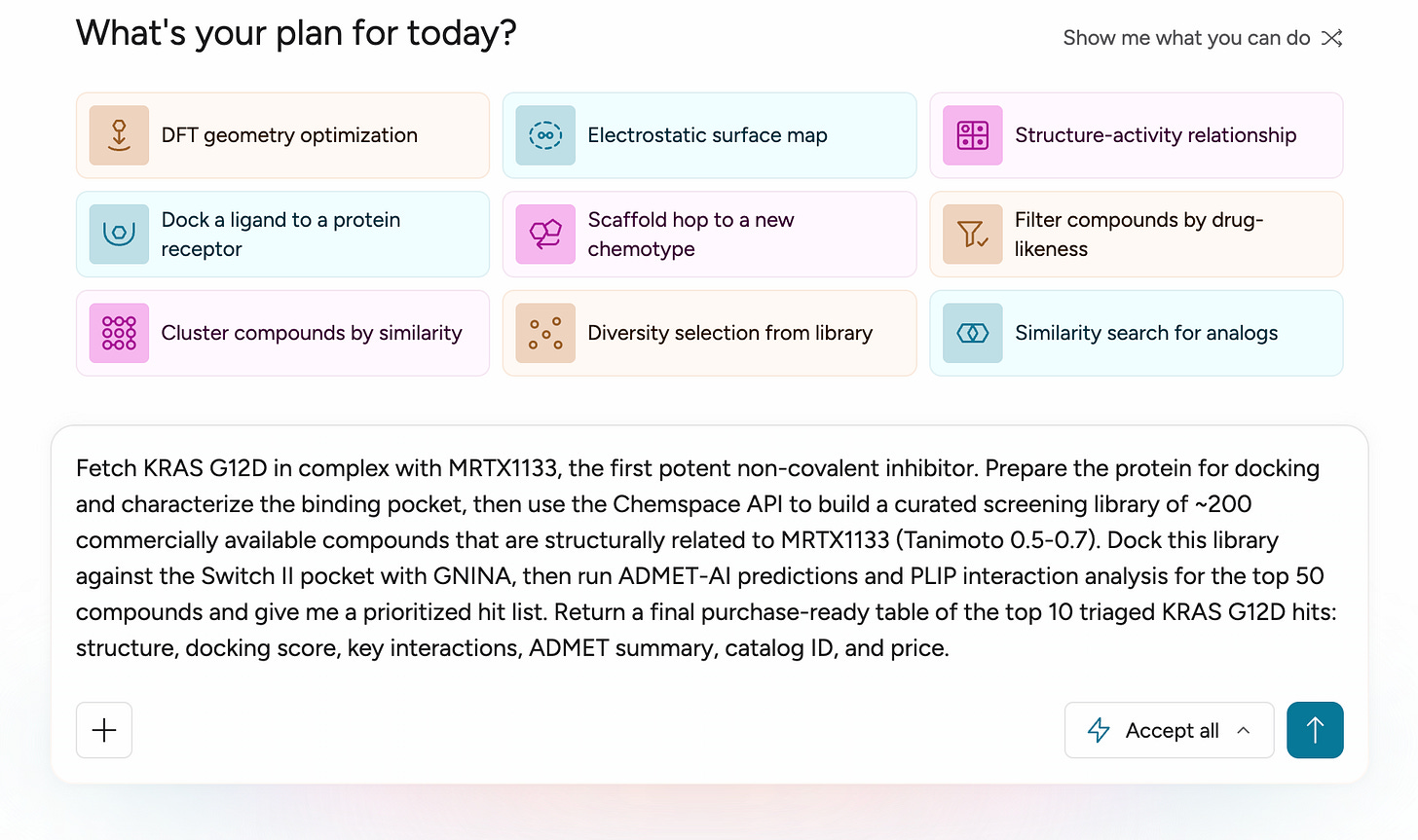
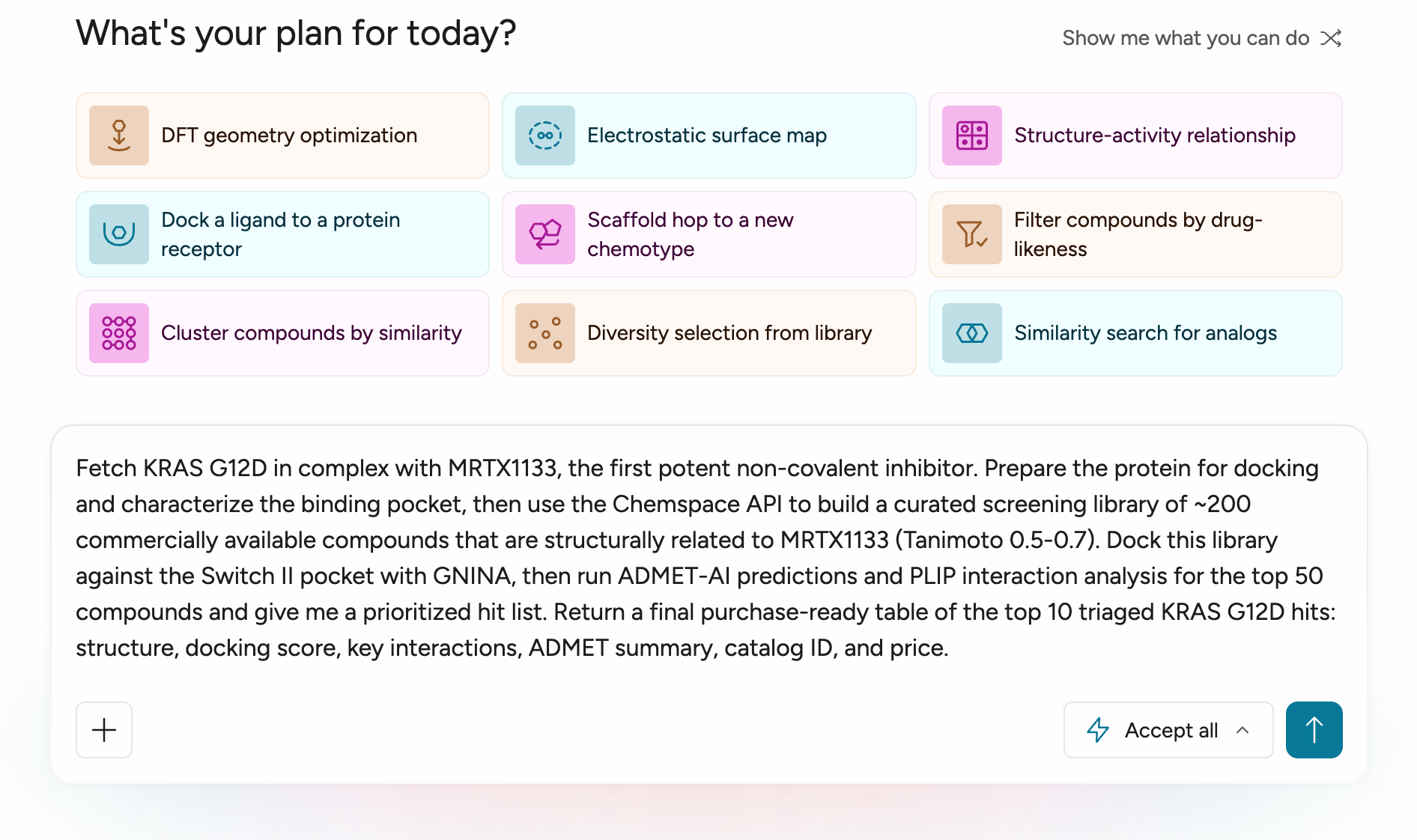
Prompting Axon to build and screen a synthesizable compound library against KRAS G12D View transcript →
Axon did exactly as prompted, using both similarity and substructure search with MRTX1133 as a reference to build a Chemspace-sourced screening library. It performed docking with GNINA on an H100 GPU, then ran ADMET-AI and PLIP interaction analysis, and ranked the compounds with a composite score. The top 10 hits all engage 8-10 key Switch II pocket residues with CNNaffinities of 8.0-8.6 and Vina scores from -8.4 to -12.8 kcal/mol. The highest ranking compound had a CNNaffinity score of 8.441 and one flagged ADMET liability, and costs $534/mg. A strong ‘value’ pick CNNaffinity of 8.428 and two flagged ADMET liabilities while costing $165/mg. Follow-up or future runs can include ADMET as a filter in building the screening library.Multi-step screening campaign for sEH (anti-inflammatory target relevant to diabetes/hypertension) using Chemspace as core infrastructure
→ I’m starting a soluble epoxide hydrolase (sEH) inhibitor program targeting inflammatory pain. Fetch the most relevant PDB structure and run a virtual screen against a diverse drug-like library (~1K compounds from ZINC) using GNINA. Query the top 100 docking hits against Chemspace to check purchasability, then run ADMET-AI predictions and analyze the protein-ligand interactions with PLIP against the purchasable subset. Give me a triaged hit list ranked by a composite of docking score, ADMET flags, and interaction quality.
→ Let’s run some short MD to assess pose stability. For the top 10 hits, run 5ns MD from the docked structures and calculate ligand RMSD. Run on 5 parallel L40S GPUs for speed, then re-rank the compounds as appropriate.
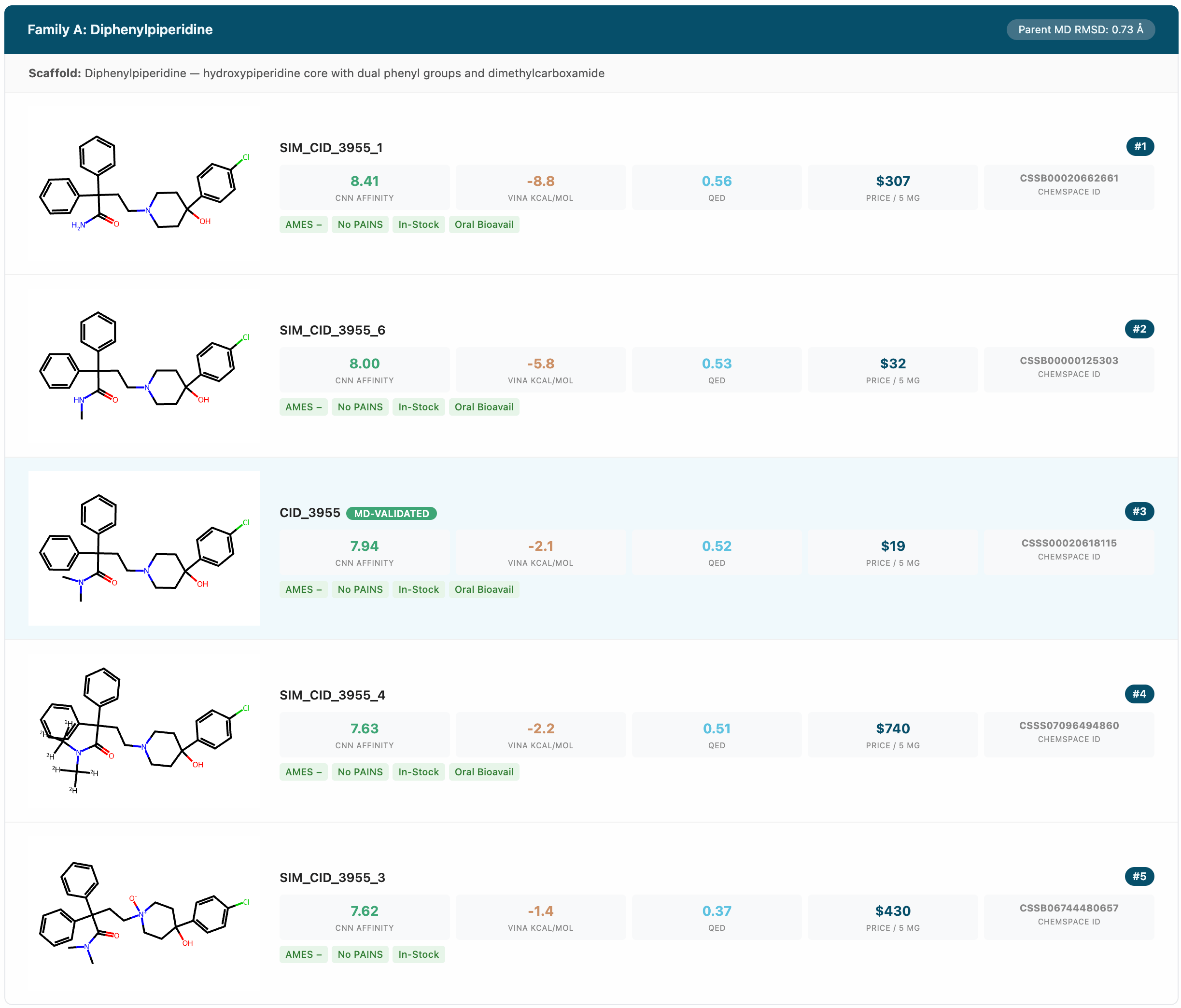
→ Now take the top 5 hits from MD re-ranking and use Chemspace similarity search to enumerate 10-15 structural analogs per compound. Identify the top 5 compounds per scaffold family via docking, then generate a final report with goals, methodology, and final purchase list organized by scaffold family.
View report →
Axon pulled PDB 4OD0 (human sEH at 1.55 Å with co-crystallized inhibitor t-AUCB) and assembled a MaxMin diversity-picked library from PubChem after ZINC returned a CAPTCHA page. After triaging the library via docking with GNINA, the top 10 compounds were validated with 5 ns explicit-solvent MD to assess pose stability, and all 10 held below 2 Å ligand RMSD. Finally, similarity search was used to find analogs of the top 5 unique scaffolds, curating a candidate list of purchasable scaffold families to build structure-activity-relationships (SAR) following experimental characterization.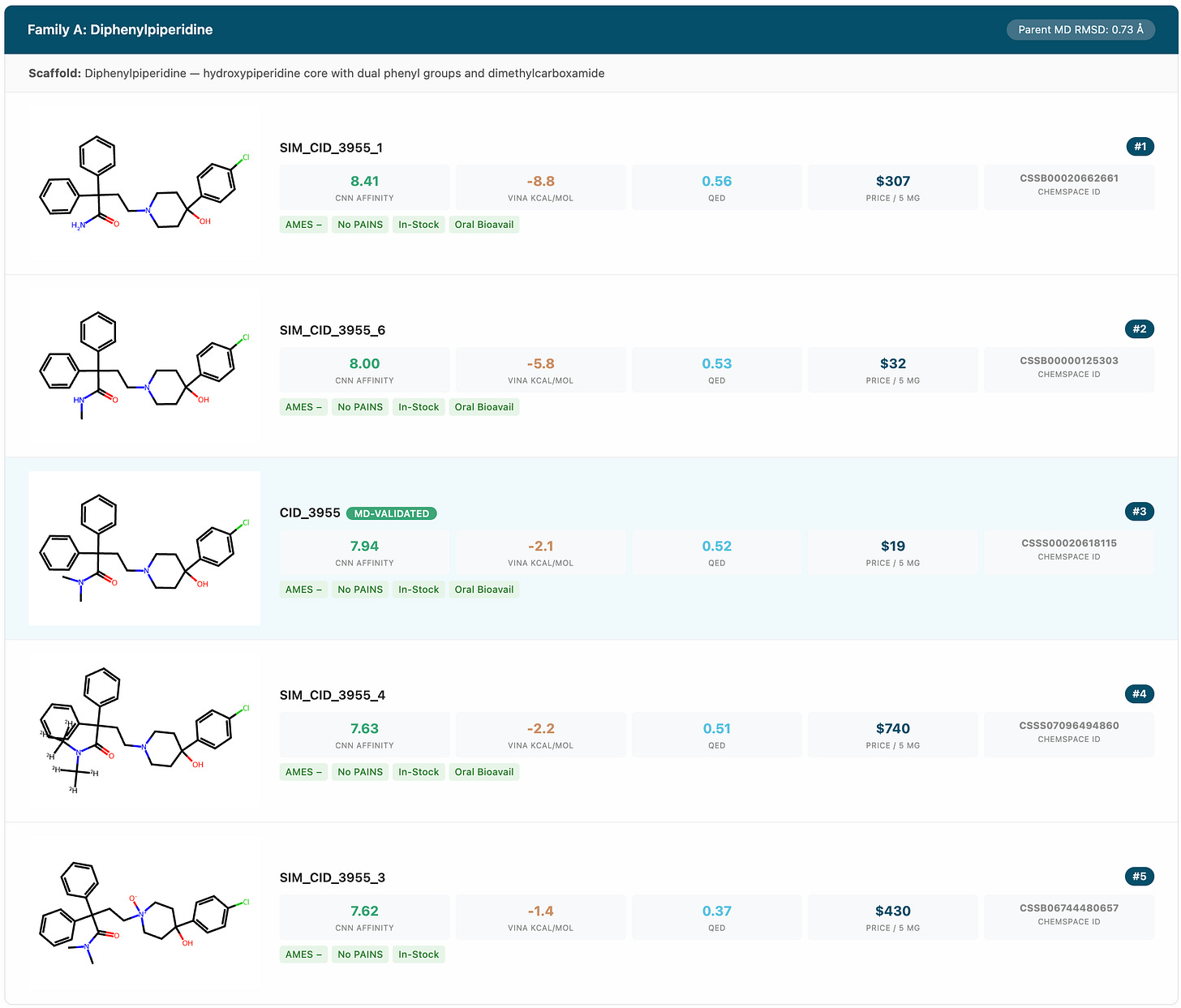
SAR analogs in the top scaffold family for sEH inhibition, identified via docking, short MD for pose stability, and similarity search Accessing IP-free chemical diversities for PRMT5, a synthetic lethality target in MTAP-deleted cancers with no approved therapeutics despite a crowded competitive landscape
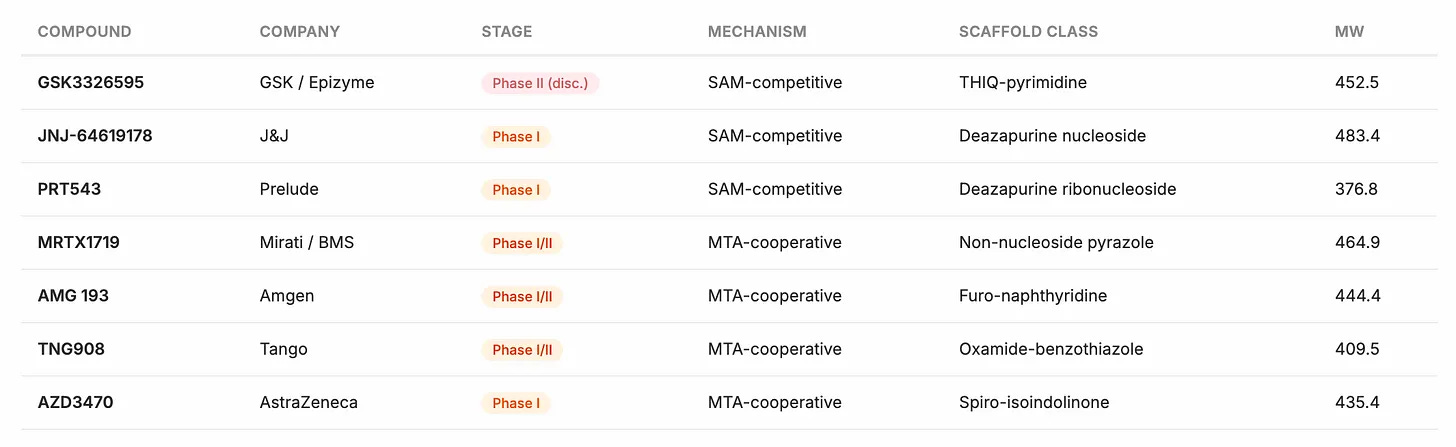
→ I want to start a PRMT5 inhibitor program with novel scaffolds outside existing IP spaces. Search the existing literature and patent space for work on PRMT5 inhibitors and return a report of key PDB structures, druggable pockets, validated ligands, and relevant competitive intelligence. Then, generate interaction fingerprints and pharmacophores for the most promising PRMT5 pocket, and search Chemspace for ~500 structurally diverse compounds that could target that site, explicitly excluding any known PRMT5 scaffold classes. Dock each against PRMT5 with GNINA and compute Tanimoto distance to known clinical PRMT5 inhibitors. Return a shortlist of 10 candidates.
→Use REINVENT to elaborate the top 5 unique scaffolds into analog series for experimental validation. Check synthesizability with Chemspace, ensuring you have 3-5 synthesizable compounds per scaffold family. Then, dock these and generate a report with the final candidate list organized by scaffold family, plus brief sections on methodology and competitive intelligence.
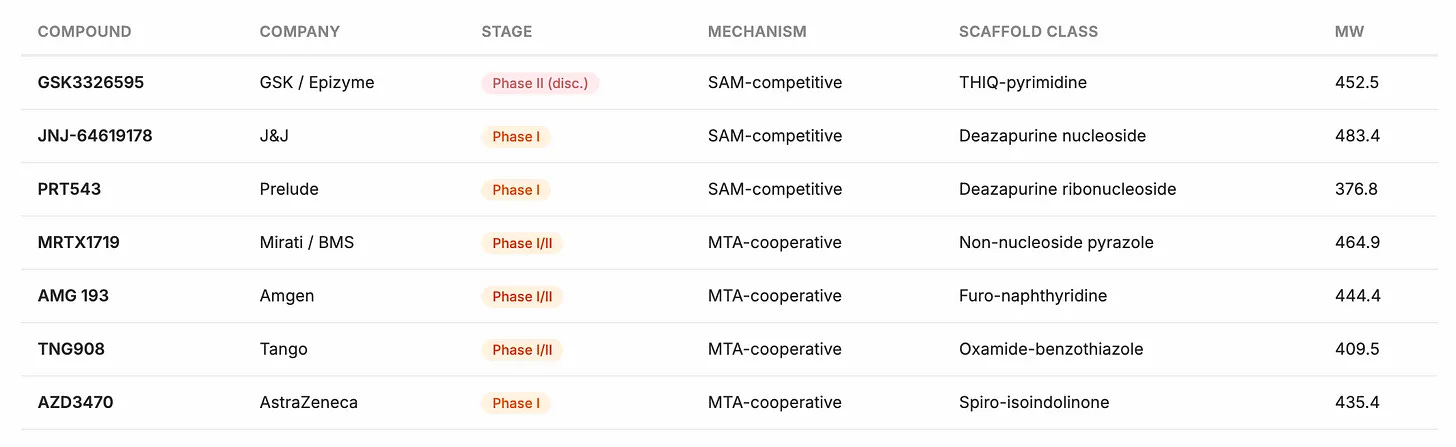
Competitive intelligence summary generated in Axon’s final report View report →
Axon used its literature and patent search tools to screen for PRMT5-specific inhibitor studies, then searched for PDB structures and decided on 9ZL3 (1.7 Å resolution, PRMT5:MEP50 with MTA + oxamide compound 18) as the primary docking target. It generated a pharmacophore model around the main pocket (“Pocket 1”) for inhibition and sourced 213 unique compounds from Chemspace across 18 diverse scaffold classes, all with Tanimoto similarity < 0.32 (Morgan r=2, 2048-bit fingerprints) to every clinical PRMT5 inhibitor. After triaging with docking, REINVENT transfer learning was used to elaborate the top 5 scaffold families (benzimidazole sulfonamide, pyrazole amide, imidazopyridine, isoquinoline amide, triazolopyridine) into analog series, yielding 25 purchasable compounds docked against PRMT5 with CNN affinities up to 6.52 pKd and mean maximum Tanimoto coefficient of 0.18.
Try it for yourself
Sign up for Axon and get started right away!
We’re super excited about Axon and always have more to say about it than fits in any blog post! If you have questions or comments or just want to talk with us, shoot me a message at sabrina@mirrorphysics.com.